Fire Safety
Fire Doors Supply & Installation from Kent, across the South East
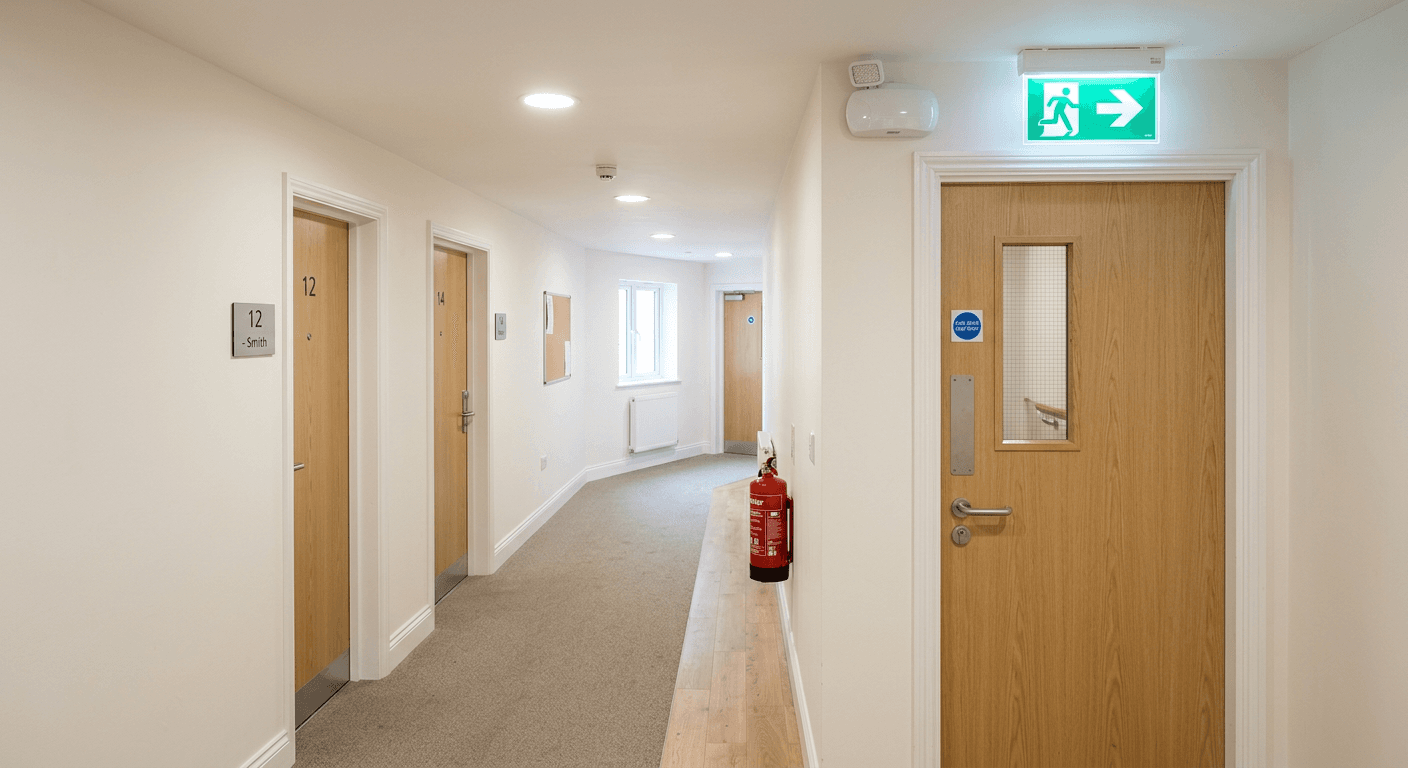
A fire door only works if it is the right door, fitted correctly. We supply and install certified fire doors with the correct frames, seals and ironmongery.
Fire Doors for commercial, public and residential buildings
Certified fire doors supplied and fitted to hold back fire and smoke. Lumina Fire & Security, Kent-based, provides fire doors work across the South East.
What is included
- Certified FD30 and FD60 doorsets
- Intumescent seals and smoke seals
- Closers, hinges and signage
- Inspection and remedial works
Certified FD30 and FD60 fire doorsets
FD30 and FD60 describe how long a door is tested to hold back fire, 30 or 60 minutes, and an S suffix means it also has smoke seals. A certified doorset is a door, frame, ironmongery and seals tested to work together, which is why mixing parts from different sources can undermine the rating. The rating needed for each door comes from the fire strategy or risk assessment, not from the door itself.
- FD30S doors on most flat entrances and corridor doors
- FD60 doors where a longer rating is specified
- Certification label or plug on the door edge
- Compatible frames, glazing and ironmongery
Installation details that make or break a fire door
A fire door can fail on the details around it. The gaps between door and frame need to be consistent and within the tolerances in the certification, and the frame must be properly fixed and the gap to the wall sealed with a tested product. Hinges, closers, locks and glazing must all be compatible with the door’s test evidence, and the closer has to shut the door fully into its frame from any angle.
- Even edge gaps, typically around 3mm, within the certified range
- Intumescent and smoke seals fitted unbroken around the frame
- Three fire-rated hinges and a closer that latches the door
- Frame-to-wall gap filled with a fire-rated sealing system
Fire door inspection duties and the 2022 regulations
Under the Fire Safety Order 2005, fire doors are fire safety measures that must be kept in good condition. In England, the Fire Safety (England) Regulations 2022 add specific duties for multi-occupied residential buildings, including giving residents information about fire doors. In buildings over 11 metres, communal fire doors must be checked at least every three months and flat entrance doors at least once a year, as far as the responsible person can reasonably manage.
- Quarterly checks of communal fire doors in buildings over 11m
- Annual best-endeavours checks of flat entrance doors
- Written records of what was inspected and found
- Defects prioritised so the most serious are fixed first
Which doors in a building need to be fire doors?
Fire doors go where they protect escape routes or stop fire spreading from one part of a building to another, and the fire strategy or risk assessment sets which doors and what rating. In blocks of flats that usually means every flat entrance door plus the doors to stairs, lobbies and corridor sub-divisions. In offices, schools and shops, typical locations are stair enclosures, corridor doors, plant rooms, kitchens and stores with a higher fire load. Cupboards housing service risers and electrical intakes are often overlooked, yet they can let fire and smoke travel between floors.
- Flat entrance doors opening onto common corridors
- Doors enclosing stairs, lobbies and protected corridors
- Plant rooms, kitchens, stores and bin rooms
- Riser and electrical cupboard doors on each floor
Common fire door defects we find
Most fire door failures come from everyday use rather than poor products. Gaps open up as frames move and hinges wear, closers are disconnected because a door feels heavy, and seals are painted over or pulled out. Occupiers also make alterations, such as new locks, letterboxes, spyholes or cat flaps, that were never part of the tested design. Cracked glazing, missing signage and doors wedged open complete the picture. Many defects can be repaired on the existing door, but where the leaf or frame is badly damaged, a replacement doorset is usually the safer and more cost-effective option.
- Edge gaps too wide or uneven after frames move
- Seals painted over, damaged or missing
- Closers removed, disconnected or badly adjusted
- Unapproved locks, letterboxes and other alterations
How the job works
- 1Start from the fire strategy and door registerWe work from your fire strategy, risk assessment or existing door register, so every door is matched to the rating and role it is meant to provide.
- 2Survey each opening in personFrames, walls, floor levels and existing ironmongery are checked at each opening, as these decide whether a door can be repaired or needs a complete doorset.
- 3Repair or replace to the test evidenceRemedial work and new doorsets use components covered by the door’s certification, from hinges and closers to glazing and seals, with no improvised substitutes.
- 4Re-check and log each finished doorEach completed door is checked for gaps, closing and latching, then logged with photos and its rating so your fire safety records stay up to date.
Fire Doors near you
Local pages with details for the areas we cover most, plus every county and city we work in.
Official guidance
- Fire door guidance for blocks of flats (GOV.UK)
- Fire Safety (England) Regulations 2022 (GOV.UK)
- Workplace fire safety: your responsibilities (GOV.UK)
Last reviewed: November 2026
Fire Doors: common questions
Can an existing door be upgraded to a fire door?
Upgrading an existing door with paint, boards or seals rarely provides a rating that can be evidenced, and is not a reliable route in most buildings. A certified doorset or a certified fire door fitted to a suitable frame is the usual answer. Where a door is in a listed building or has heritage value, specialist upgrade options exist and need assessing case by case.
What does a fire door inspection report include?
Each door is identified and checked for its label, condition, gaps, seals, hinges, closer, latch, glazing and signage, and any damage or alterations are noted. Doors are usually given a pass, repair or replace outcome with photos. The report gives the responsible person a clear list of actions and evidence that the doors have been checked.
Our fire door closes too hard or does not shut fully. Is that a problem?
Yes. A door that does not close and latch on its own will not hold back smoke or fire, and one that slams can cause injuries and gets wedged open as a result. Most cases are fixed by adjusting or replacing the closer, or by easing a door that is catching on its frame. We check that the door closes from any angle once adjusted.
Can fire doors be held open in busy corridors?
They can, but only with the right equipment. Hold-open devices or swing-free closers linked to the fire alarm release the door so it closes when the alarm sounds. Wedges, hooks and fire extinguishers used as doorstops are not acceptable. We can fit compliant hold-open devices and link them to your fire alarm system.
Related services
Fire Risk Assessments
A written assessment of the fire risks in your building, with a clear, prioritised list of what to do about them.
Fire Alarm Installation
Conventional, addressable and wireless fire alarm systems designed around your building.
Fire Alarm Servicing
Scheduled maintenance visits and certification to keep your system reliable and compliant.
Get in touch
Talk to an engineer about your building.
Free, no-obligation surveys and quotes for commercial, public and residential properties. Call us or drop us an email and we will get straight back to you.