Fire Safety
Fire Alarm Servicing from Kent, across the South East
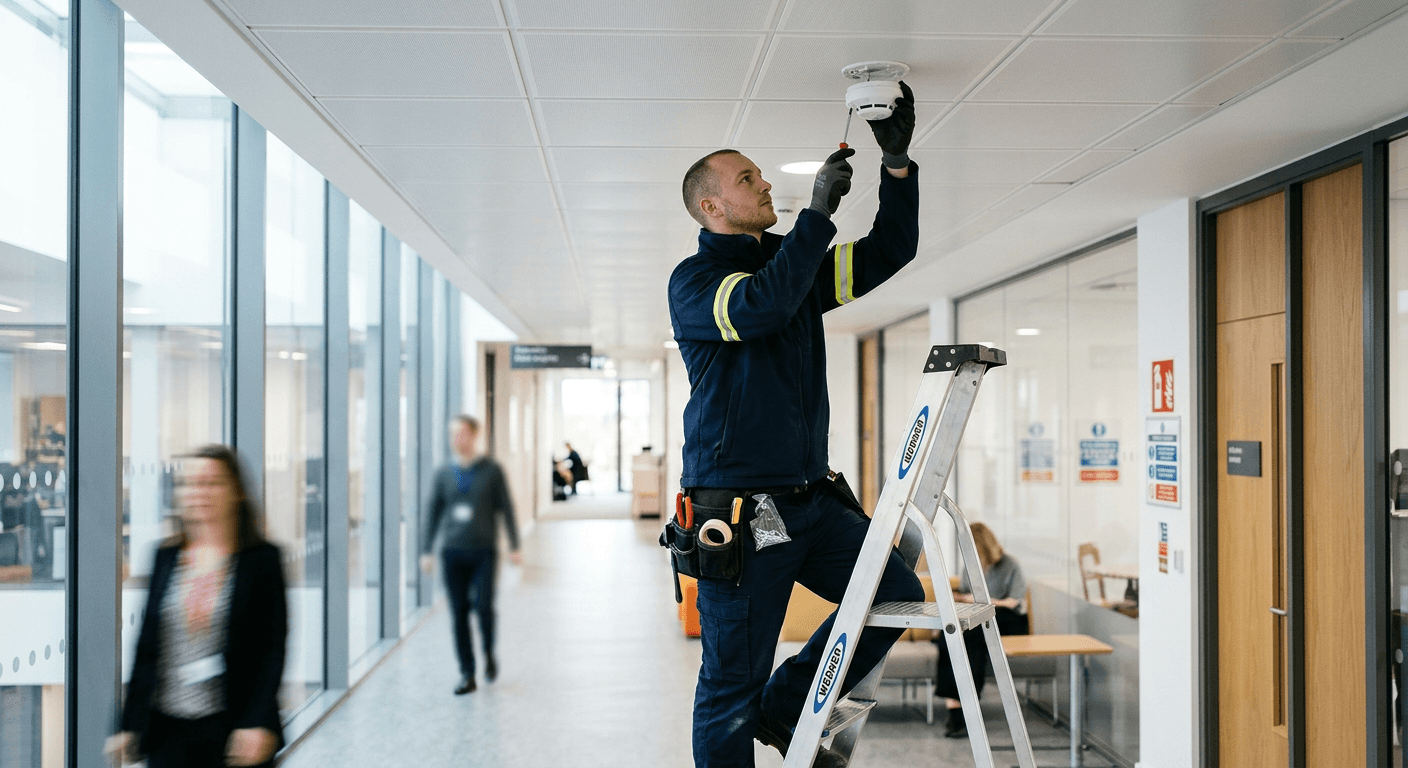
Regular servicing keeps your fire alarm working when it matters. We maintain systems of all makes, provide clear reports and fix faults before they become problems.
Fire Alarm Servicing for commercial, public and residential buildings
Scheduled maintenance visits and certification to keep your system reliable and compliant. Lumina Fire & Security, Kent-based, provides fire alarm servicing work across the South East.
What is included
- Planned maintenance visits
- Detector, sounder and panel testing
- Fault finding and remedial works
- Service certificates and logbook updates
How often should a fire alarm be serviced, and whose duty is it?
Under the Regulatory Reform (Fire Safety) Order 2005, the responsible person for a non-domestic building, or the common parts of a block, must keep fire safety equipment maintained in efficient working order. BS 5839-1 recommends a service by a competent engineer at least every six months, with a weekly test of a call point carried out by the building’s own staff. Larger or higher-risk sites sometimes split the work across quarterly visits.
- Service visits no more than six months apart under BS 5839-1
- Weekly call point test, using a different call point each week
- Every detector and call point tested over the course of a year
- Results and faults recorded in the system logbook
What a fire alarm engineer checks on a service visit
A service starts with the logbook, so the engineer can follow up on faults, false alarms and work since the last visit. The panel, power supplies and standby batteries are then tested, followed by a share of the detectors, call points and sounders. Any links the alarm controls, such as door release, plant shutdown or AOV operation, are checked so the cause and effect still does what the design intended.
- Panel indications, controls and fault monitoring
- Standby battery and charger condition
- Detectors tested with smoke, heat or multi-sensor test kit
- Sounders and beacons checked for audibility and operation
Fire alarm faults and false alarms
Common faults include earth faults, open or short circuits on a loop, failed batteries and detectors that have reached the end of their life. False alarms are usually a design or use problem rather than a broken part, such as a smoke detector beside a kitchen, shower or dusty process. Finding the cause matters, because repeated false alarms lead people to ignore the alarm and can lead to call-out charges or delays from the fire service.
- Detector types changed to suit steam, dust or cooking fumes
- Contaminated or ageing detectors replaced
- Wiring and loop faults traced and repaired
- False alarm history reviewed from the logbook
Servicing fire alarms in flats, HMOs and mixed-use buildings
Residential and mixed-use buildings bring their own servicing challenges. A system covering the common parts of a block is normally maintained in line with BS 5839-1, while HMOs and converted buildings often have BS 5839-6 systems with interlinked detectors inside each dwelling. Getting into flats, keeping residents informed and knowing which detectors belong to which system all need planning. Where a shop or restaurant sits below flats, the commercial alarm and the residential system may be separate, linked, or wrongly assumed to be linked, so we confirm how they interact before any testing starts.
- Common-area systems in blocks of flats and sheltered housing
- Grade A and Grade D systems in HMOs and conversions
- Resident notices and access arranged ahead of testing
- Links between commercial and residential alarms checked
Signs a fire alarm is reaching the end of its life
A fire alarm does not need replacing just because it is old, but there comes a point where servicing alone is not enough. Panels no longer supported by the manufacturer become hard to repair, and a single failed board can leave a building without a working system while parts are found. Recurring loop faults, frequent false alarms and detectors past their recommended life all add cost at every visit. When those patterns show up in the logbook, we set out the options, from replacing devices in phases to fitting a new panel on the existing cabling, so you can plan the spend.
- Panel parts discontinued or only available second-hand
- Repeated faults on the same loop or zone
- Detectors past the manufacturer’s recommended life
- Building changes the original design no longer reflects
How the job works
- 1Book the visit around the buildingDates are fixed around opening hours, residents or production, and we agree who will be on site to silence the alarm, isolate outputs and open locked areas.
- 2Isolate outputs and warn occupantsBefore testing begins, signals sent off site and links to plant or door releases are isolated, and occupants are told that sounders will operate briefly.
- 3Test zone by zoneThe panel, batteries and the scheduled share of detectors, call points and sounders are tested, with faults and dirty or ageing devices noted as the engineer works through.
- 4Restore the system and report backOutputs are reinstated, the panel is left clear of faults where possible, and you receive a service certificate, a logbook entry and a written list of recommended remedials.
Fire Alarm Servicing near you
Local pages with details for the areas we cover most, plus every county and city we work in.
Official guidance
- Regulatory Reform (Fire Safety) Order 2005 (legislation.gov.uk)
- Workplace fire safety: your responsibilities (GOV.UK)
Last reviewed: November 2026
Fire Alarm Servicing: common questions
Can you take over servicing from our current fire alarm company?
Yes. We service most makes of conventional, addressable and wireless panel. On the first visit we check the existing logbook and certificates, carry out a full service and give you a clear report of the system’s condition. Some panels use manufacturer-specific software, and if access codes or tools are needed we will tell you before booking so the visit is not wasted.
What happens if a service finds a problem with the system?
Minor issues such as a failed battery or a dirty detector are often dealt with on the day. Anything larger is written up in the service report with a clear explanation and a quote for the remedial work, so you can decide how to proceed. Faults are also noted in the logbook, which helps show that the responsible person has acted on them.
Does a fire alarm engineer need to shut the building down during servicing?
No. Testing is planned so the building can stay in use, usually by working through the system zone by zone and warning occupants before sounders are tested. Where the alarm sends signals elsewhere or controls plant, we agree how those are isolated during the test so nothing shuts down unexpectedly and no false call is sent.
Do fire alarm detectors need replacing after a certain number of years?
Detectors do not last forever. Dust, insects and ageing electronics make them less reliable over time, and many manufacturers recommend replacement at around ten years. We check the age and condition of devices at each service and recommend replacements based on what we find and the manufacturer’s guidance, rather than replacing whole systems unnecessarily.
Related services
Fire Risk Assessments
A written assessment of the fire risks in your building, with a clear, prioritised list of what to do about them.
Fire Alarm Installation
Conventional, addressable and wireless fire alarm systems designed around your building.
AOV & Smoke Ventilation Installation
Automatic opening vents and smoke control systems for stairwells and common areas.
Get in touch
Talk to an engineer about your building.
Free, no-obligation surveys and quotes for commercial, public and residential properties. Call us or drop us an email and we will get straight back to you.